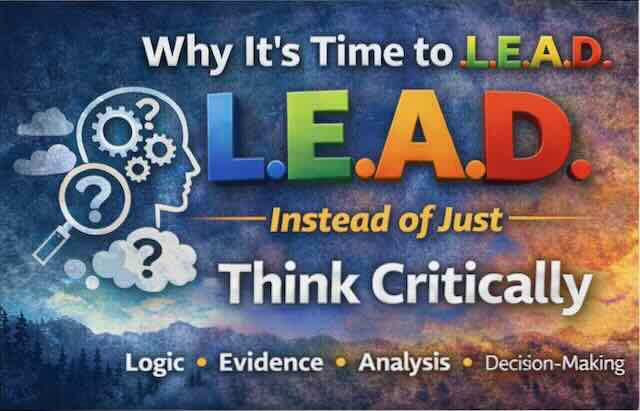
In today’s world, we often hear the call to “think critically”—whether we’re making personal decisions, debating big issues, or trying to navigate a sea of information. But what does “critical thinking” really mean, and is it enough to guide us to the best outcomes? Let’s dive in.
Defining Critical Thinking
At its core, critical thinking is the ability to think in a clear, rational way. It involves analyzing information, questioning assumptions, evaluating evidence, and drawing reasoned conclusions. It’s a broad skill set that can be applied in countless ways and contexts. However, because it’s so broad, “critical thinking” can sometimes be a bit of a catch-all phrase—it doesn’t always guarantee that we’re relying on the most solid, evidence-based approach.

Introducing L.E.A.D.: Logic and Evidence Analysis & Decision-Making
This is where L.E.A.D. comes in. L.E.A.D. stands for Logic, Evidence, Analysis, and Decision-Making, and it’s a more focused framework for approaching problems and decisions. Instead of just thinking critically in a general sense, L.E.A.D. is about rooting your reasoning firmly in logic and hard evidence. It’s a commitment to a step-by-step process that ensures your conclusions are as fact-based and reliable as possible.
How L.E.A.D. Differs from Traditional Critical Thinking
To see the difference more clearly, let’s break it down:
| Aspect | Critical Thinking | L.E.A.D. (Logic & Evidence Analysis & Decision) |
|---|---|---|
| Definition | General process of analyzing and evaluating information to form a judgment. | A structured approach emphasizing logic and evidence as the foundation of decision-making. |
| Focus | Broad; can include emotional, intuitive, or contextual reasoning. | Narrow and disciplined; prioritizes logical steps and verifiable evidence. |
| Methodology | Involves questioning, evaluating arguments, and considering multiple viewpoints. | Involves a step-by-step reliance on logic and evidence. |
| Outcome Difference | May lead to diverse conclusions depending on context and individual perspectives. | Aims for more consistent, reliable outcomes anchored in logic and fact. |
Why L.E.A.D. Matters
By shifting from general “critical thinking” to L.E.A.D. thinking, we’re advocating for a more consistent and objective approach to decision-making. L.E.A.D. helps ensure that our conclusions are grounded in logic and evidence, reducing the influence of bias and helping us arrive at more reliable outcomes. In other words, it’s not just about thinking critically—it’s about leading with logic and evidence every step of the way.
So let’s start using the term L.E.A.D. thinking. By doing so, we’re making a commitment to a more rigorous, reliable way of navigating the world—one logical step at a time.
